
Searching Hunt County Criminal Dockets
Begin with the exact court printed on your notice, bond paper, or prior order. The Hunt County Docket Search organizes results by court and setting date. Leave the date blank and it shows the next 30 days. Pick a date and it shows that day. It is a date tool, not a party-name criminal index. It cannot replace the clerk's file.
If you have the cause number, use it. Felony records sit with the Hunt County District Clerk. A misdemeanor in County Court at Law belongs to the Hunt County Clerk. Class C cases stay with the municipal or Justice Court that issued them.
- Copy the court, cause number, party spelling, and setting date.
- Check the county date search by court and date.
- Compare the cause number in re:SearchTX when available.
- Ask the correct clerk for the docket sheet, charging paper, judgment, or sentence.
- Choose inspection, a plain copy, or a certified copy.
Hunt County Criminal Offense Routing
Criminal records in Hunt County split by jurisdiction. Felonies and related post-conviction matters go to the 196th and 354th District Courts. Class A misdemeanors land in County Court at Law Nos. 1 and 2. Class B misdemeanors land there too. Justice and Municipal Courts keep the Class C and citation dockets.
| Record | Court | Keeper |
|---|---|---|
| Felony | 196th or 354th District Court | District Clerk |
| County misdemeanor | County Court at Law | County Clerk |
| County citation | Named Justice Court | JP clerk |
| City Class C matter | Municipal Court | City clerk |
Remember that an arrest or booking is a law-enforcement event, not a court outcome. Check the cause number and court before you draw any conclusion from an entry.
Inside a Hunt County Criminal Docket
Think of a Hunt County criminal docket as an event log. A public date result may show less than the full history. Images can be missing for several reasons: security limits, incomplete digitization, or the District Clerk rule that district documents stay off the internet.
| Court and cause number | Identify the tribunal and matching key. |
|---|---|
| Charge or case type | Names the filed category, not guilt. |
| Setting | May list arraignment, pretrial, plea, trial, or sentencing. |
| Motion | Shows a request was filed, not granted. |
| Disposition | Gives shorthand; the signed order states the full result. |
| Document access | May link a file or require a clerk request. |
Record the search date because settings and access can change.
Hunt County Criminal Setting Terms
Labels carry weight on a docket. An indictment is a charge, never a conviction. An arraignment or pretrial setting marks a stage, not an outcome. A plea setting may lead somewhere, but only the judgment controls.
- Reset
- A new setting that moves an older date.
- Deferred adjudication
- A disposition with supervision terms, not a label to rewrite.
- Dismissal
- A disposition without conviction on the charge reflected in that record.
- Writ or habeas
- A collateral or post-conviction proceeding.
Read later Hunt County docket entries for amendments, supervision events, and appeals.
How a Criminal Case Moves
The broad process is Filing → Arraignment → Pretrial → Plea or Trial → Disposition → Sentencing. Not every Hunt County criminal case reaches each stage. A case can be reset, dismissed, amended, or transferred.
A docket gives you events and dates, not the judge's full reasoning. When the result matters, request the judgment, dismissal, sentence, or supervision order. For name and number searches, the Hunt County case lookup explains the process.
District Clerk Criminal Requests
The Hunt County District Clerk keeps the felony files for District Court. Its official form states that district documents are not viewable online. With a known number, you can file through eFileTexas. Without one, send the request to dclerk@huntcounty.net or P.O. Box 1437, Greenville, Texas 75403-1437. The office gives no case information by phone.
Expect to supply party names, filing year, case type, and the exact paper you need. Fees listed on the form include a $5 name search, waived when you provide a case number. Paper copies add $1 per page. Certification costs $5 per document. Electronic delivery runs $1 for pages one through ten, then $0.10 per added page. The clerk sends a cost statement before payment.
Hunt County District Clerk
2507 Lee Street, Second Floor
Greenville, TX 75401
(903) 408-4172
Monday through Friday, 8:00 a.m. to noon and 1:00 p.m. to 5:00 p.m.
Courts That Hold Criminal Dockets
Contacts, standing orders, local rules, and docket controls are gathered on the official District Courts page. That page helps with procedure. The filed record itself still sits with the clerk. The official page displays a card for each of the two Hunt County District Courts.
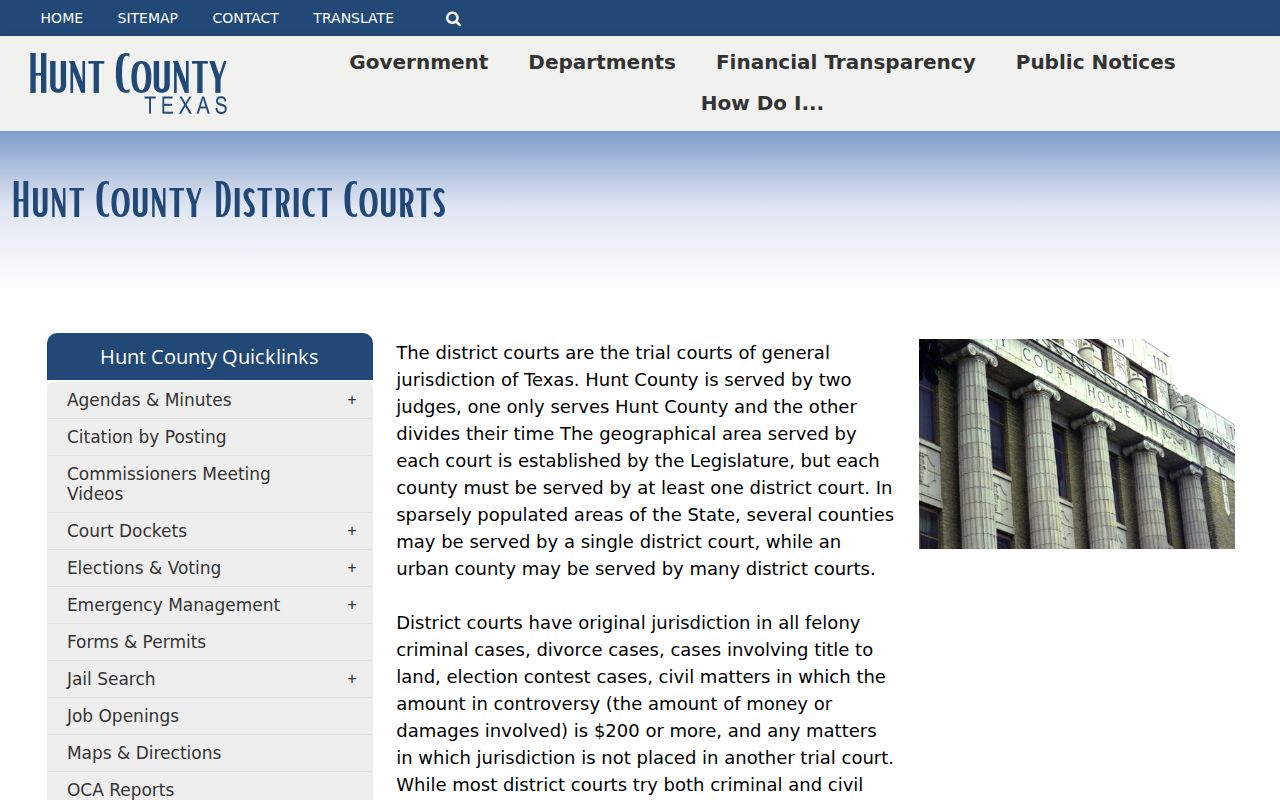
Because the courts are separate, every felony request should name the assigned court and cause number. County misdemeanors take a different route through the County Clerk and County Court at Law.
Hunt County Criminal Access Layers
Three systems answer three different questions. Hunt County Docket Search covers date-based settings. re:SearchTX adds a statewide electronic layer, though its content varies with each court's integration, role rules, and security. eFileTexas is a filing route, not a promise of public document viewing.
Misdemeanor searches run through the County Clerk's county-authorized services. The clerk's Tyler disclaimer calls the index a catalog guide rather than a certification and suggests trying spelling variants. If images fail during backups, retry later or request a copy. A blank result is never a court finding.
Hunt County Misdemeanor Files
Misdemeanor records for the County Courts at Law live with the Hunt County Clerk. That office is separate from the District Clerk, though both serve courts in Greenville. The official County Clerk page describes the office's court role. The request page routes you to online judicial records and copy procedures. The office has also offered public search computers during stated weekday hours.
Regular copies run $1 per page, the County Clerk says. Only the office can issue certified copies. The judicial request form listed $5 for certification and seal per document, on top of page charges. Verify the live fee before sending payment. Mail payments should use a cashier's check or money order under the published instructions. A portal printout is not a clerk-certified Hunt County criminal record.
Sealed Dockets and Public Access
Plenty of Hunt County criminal docket fields are public, but access has limits. Sealed cases, juvenile matters, secure filings, and some warrant material may be missing or redacted. Juvenile confidentiality is governed by Texas Family Code Chapter 58.
Access boundary: Texas OCA policy separates court-case records from Rule 12 administrative judicial records. Criminal file requests go to the originating clerk.
Ask the clerk which rule applies and whether inspection or a redacted copy is possible. Never try to slip past a restriction through some other portal.
Hunt County Criminal Outcome Checks
A docket line can read plea, dismissed, disposed, or sentencing. Yet the real answer usually lives in a signed order. Ask the clerk for that exact instrument. On the felony side it might be an indictment, a judgment, or a sentence. It could also be a dismissal or a supervision order. For a county-level misdemeanor, send the same precise request to the County Clerk.
Quote the court's own language when you report an outcome. Do not stretch "no contest" into "guilty." Do not treat a setting as a conviction or flatten deferred adjudication into something simpler. Hang onto the cause number, the court, the filing date, and whether the copy is certified. Those details anchor a Hunt County criminal docket result to the correct case.
Outcomes often take more than one date to read. The plea date, the disposition date, the sentencing date, and the date supervision began can all be different days. Later entries may add a motion to revoke, to adjudicate, to modify conditions, or to discharge supervision. Follow that sequence through the docket. Pull the later signed orders instead of quitting at the first label. One disposition word rarely tells the whole story.
Appeals need their own check. A notice of appeal in the Hunt County trial docket says nothing about how the appeal ended. Save the trial-court cause number. Then work from the appellate case number through the Sixth Court of Appeals route tied to Hunt County. The trial clerk still issues the certified trial judgment. The appellate clerk keeps the appellate docket and the opinion.
Hunt County Criminal Search Troubleshooting
A criminal setting will not show up sometimes. Look at the court selector and the date format first. The Hunt County tool takes MM/DD/YYYY and YYYY-MM-DD. Leaving the date blank pulls the coming 30-day view. Then set the citation or notice beside the court you selected. A city case or a JP case never turns into a District Court record. The event happening in Hunt County does not change that.
Spell the party name a few different ways, but only in a system that truly supports party searches. From there, run the cause number through re:SearchTX and file the responsible clerk's request form. Read the clerk's answer carefully. A sealed file, a non-integrated case, an unavailable image, and no matching record are four different outcomes. Before a pending hearing, confirm the setting with the court coordinator close to the date. Resets and cancellations can post after an earlier search.
Keep a small paper trail: the clerk's response, your search date, the court you picked, and the range you ran. That record separates a temporary access hiccup from the clerk's actual search result.