
Searching the Commerce Court Docket
The issuing agency tells you where the case lives. A Commerce police citation normally lands in Commerce Municipal Court. But a ticket from a sheriff, constable, game warden, or Texas Highway Patrol officer is different. It may belong to a Hunt County JP precinct instead. For a confirmed municipal matter, start online. The city-authorized portal is the fastest route for the docket. When it comes back blank or thin, call the clerk. Nothing beats direct contact for a case lookup the portal cannot finish.
- Read the court, issuing agency, citation number, and appearance date from the original ticket.
- Open the city-authorized Commerce Municipal Online Services portal and choose one search method.
- Use citation number with the required matching field when available because it is narrower than a name search.
- Compare a result's court and citation identity before recording the public status, date, violation, or balance.
- If no reliable result appears, call Commerce Municipal Court at 903-886-1100 or visit during verified counter hours.
- If the citation names a JP court, leave the city portal and contact that precinct. For a higher case, use the matching Hunt County clerk.
Six Commerce Citation Search Paths
The Commerce portal offers six ways in. You can search by citation number with date of birth, or by driver license and issuing state with date of birth. Social Security number with date of birth works too, as do license plate and state, plain name, or business name. Those are portal field labels, nothing more. They should not be collected or displayed anywhere outside the portal.
| Method | Matching requirement | Use carefully |
|---|---|---|
| Citation number | Date of birth | Most direct when the ticket is available |
| Driver license | Issuing state and date of birth | Enter only on the official portal |
| Social Security number | Date of birth | Never test with a sample or preserve the value |
| License plate | Plate state | Verify the returned citation and court |
| Name | Name fields shown live | Broader and vulnerable to similar-name matches |
| Business name | Business field shown live | Confirm entity and citation identity |
The Commerce municipal citation portal lays out those search choices on its docket search screen. Some functions may ask for sign-in or registration.
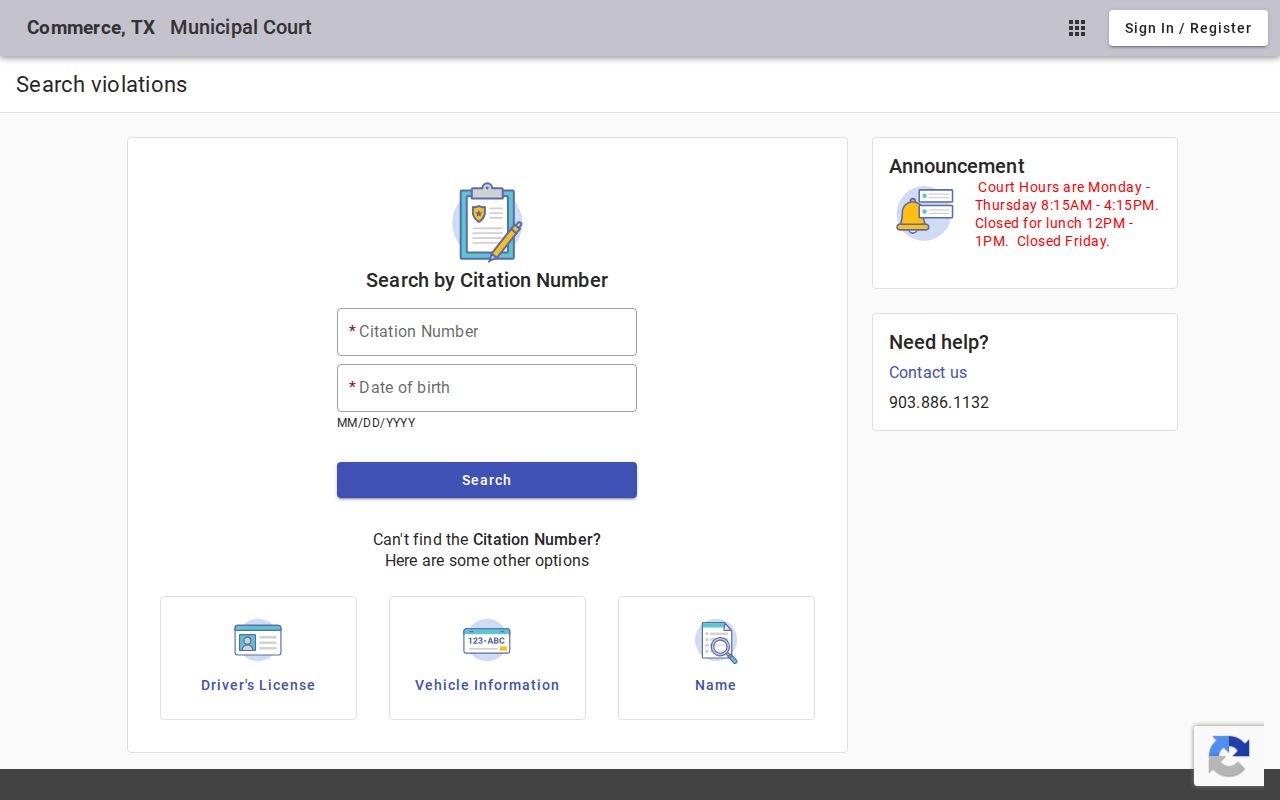
Work with the blank interface only. Never publish an authenticated screen, a real citation result, or a sensitive identifier.
Commerce Municipal Court Basics
The official Commerce Municipal Court page places the city court at 1119 Alamo Street. It also lists the contact number, 903-886-1100. Its docket covers city-level traffic, Class C, and ordinance matters and nothing larger. It is not a Hunt County civil, felony, probate, family, or county-misdemeanor search. Do not push it past its job. The counter hours run 8:15 a.m. to 4:15 p.m., Monday through Thursday. The window closes for lunch from noon to 1:00 p.m. and all day Friday. Those are service-window hours, not a hearing calendar. Confirm them before you drive over. Then ask the clerk about your specific setting. Do not read a court date out of the office schedule. For location and current service instructions, the city court page is the word that counts.
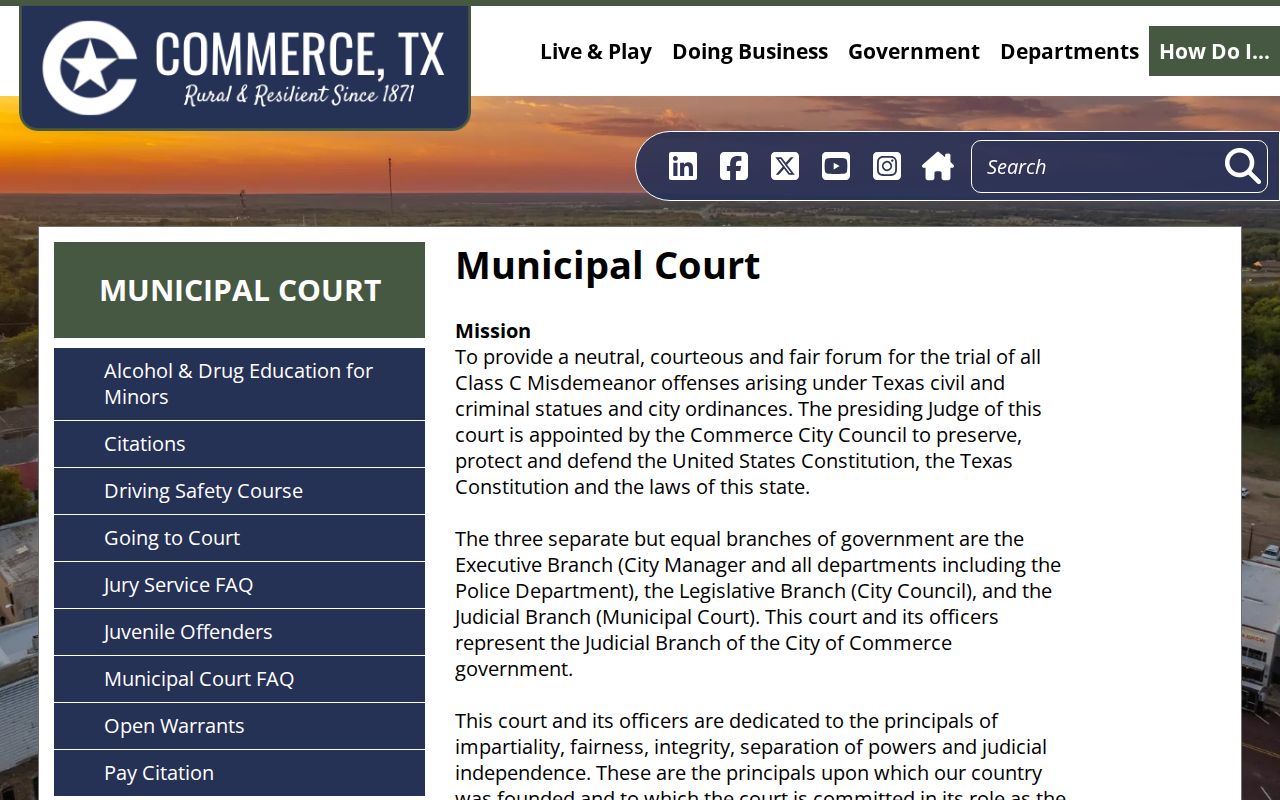
Before a clerk-counter visit, check the official court notice again. The vendor portal can change on its own, apart from the court.
Protect Sensitive Commerce Search Values
Your date of birth, driver-license data, Social Security number, and plate number are matching inputs. They are not public research fields. Enter them only in the verified city-authorized portal. Keep them out of screenshots, browser notes, email subject lines, shared worksheets, and published examples. A safe record of your lookup notes the method you picked. It does not copy the value you typed. For a Commerce lookup you can repeat later, keep the essentials. Note the search date, the portal name, and whether sign-in was requested. Add the result court, the citation number, and the public status labels. That is enough to tell one court file from another. If the portal returns a similar name, stop. Demand the citation number or direct court confirmation. Only then tie the match to a specific matter.
Do not test the Social Security path: The portal's presence of that option can be documented from the blank form. There is no reason to enter a sample number or retain a real person's value in order to explain the Commerce search process.
Court Dates and Settings in Commerce
A Commerce court date can surface in three places. Check the citation, a later municipal notice, or a public portal result. Treat the printed appearance date as your first reference. When two dates clash, or a hearing gets reset, the municipal clerk settles it. The office schedule will not hand you a hearing date. And a payment due date is not automatically a trial setting. Label it carefully.
| Date | The appearance or hearing date shown on the citation, later notice, or confirmed docket. |
|---|---|
| Time | The individual setting or docket-call time supplied by Commerce Municipal Court. |
| Location | 1119 Alamo Street unless the current court notice directs otherwise. |
| Judge | The presiding municipal judge identified on the current setting or by the clerk. |
| Setting Type | Appearance, pretrial, trial, compliance, or another municipal event label. |
Save the search date with any online result. A Commerce setting is a snapshot that can be reset, continued, or corrected after you viewed the screen.
Match, Payment, and Certified Copy
The Commerce service pairs citation searching with payment functions. But the two outputs carry different weight. A search result only confirms the vendor turned up a possible city record. A payment page may show an amount due. Neither one necessarily shows the full plea history, the sequence of events, the disposition, or a signed order in the clerk's file. Do not mistake either for the complete court record.
| Output | What it may establish | What it does not guarantee |
|---|---|---|
| Search result | A possible Commerce citation match and public labels | Complete docket history or identity from name alone |
| Payment option | An amount the vendor currently accepts | Every plea term or final disposition |
| Certified copy | An authenticated municipal court record | Records held by JP Precinct 2 or a county clerk |
Verification boundary: Call the Commerce clerk when the question is whether a plea, course document, compliance item, deferral, or payment was accepted and entered.
Traffic Tickets in Commerce
A Commerce police citation generally creates a Commerce Municipal Court record. From there your options fork. You can pay, contest, request a driving-safety course, seek deferred disposition, or ask about a compliance dismissal. Each is a separate choice. The city court controls the current forms, deadlines, fees, and eligibility rules. A portal balance is no stand-in for reading the citation and getting current instructions. Tickets from state or county officers may never show up in the Commerce city portal. Hunt County's guidance routes DPS, sheriff, constable, and game-warden matters into the JP system. Which office applies depends on the ticket. For a side-by-side of those agency routes, the Hunt County traffic ticket page compares them. The Commerce search should stay fixed on city-held records.
Where Commerce Cases Go
Not every Commerce legal matter stays at City Hall. Class A and B misdemeanors, along with certain county-level cases, sit with the Hunt County Clerk and the County Courts at Law. Felony, divorce, family, and major district civil records go to the District Clerk instead. The District Courts handle that side. The split tracks the charge. An appeal from a municipal or JP case can even open its own County Court at Law cause number.
Docket flow: Commerce Municipal Court › Hunt County Courts at Law › District Court or appellate route as jurisdiction requires
Think of that routing as a map, not a promise. A Commerce case does not always climb the ladder that way. Charges can sit, drop, or resolve at one level. If an appeal does create a county record, keep the original municipal citation number. Ask the city clerk how the file was transmitted. The Hunt County court docket page walks the county-wide search routes.
Why a Commerce Search Can Be Blank
A blank docket search does not mean the case is gone. The wrong court may have been searched. The citation may not have posted yet. A name and identifier may simply not match. Some results appear only after account sign-in. Older or restricted files can stay out of public view. Use exact spelling and the court's official matching method. Never cycle through other people's sensitive identifiers, and never assume absence after one try.
A failed citation number search calls for a closer look. First, confirm the ticket actually names Commerce Municipal Court. If it names JP Precinct 2 or another court, take the request to that office instead. If it is municipal, call 903-886-1100 during verified hours. Have the citation number, the name, the approximate issue date, and the violation ready. A direct answer from the clerk is part of the Commerce access route. It is not merely a last resort.
Commerce Court Record Access Rules
Public access has limits in Commerce. Texas court-access rules, sealing orders, and confidentiality provisions all shape what appears online for a judicial case record. Administrative judiciary records answer to Rule 12 instead. The Texas Public Information Act carries a judiciary exclusion, so a routine city records request is not automatically the right procedure for a municipal case file. Match the request to the record.
Key rules:
Texas Rule of Judicial Administration 12 concerns access to judicial administrative records rather than filed case substance.
Texas Government Code Chapter 552 contains the judiciary boundary relevant to Public Information Act requests.
Texas Code of Criminal Procedure Chapter 45 supplies statewide procedure for municipal and justice-court criminal matters.
Ask the Commerce court clerk how to request the record. Even when a public docket entry exists, juvenile, sealed, protected, and personally identifying material may be withheld or redacted.
Requesting a Certified Commerce Record
A certified copy has one source. It comes from whichever office holds the original file. Give the Commerce clerk the citation number, the full name, the approximate issue date, the violation, and any known court date. Say exactly what product you need. That could be a certified disposition, a signed order, a public docket history, or available payment history. Ask for a current fee quote and delivery instructions rather than importing a fee from another city or a vendor screen.
The file may not be municipal at all. If the clerk points to JP Precinct 2, reroute the request there. An appeal changes things. When a city matter was appealed, keep both identifiers and ask which Hunt County court now holds the case. A County Clerk copy never replaces the municipal record of the proceedings that happened before the appeal.
Commerce Population Is Not Caseload
The 2020 Census put 9,090 people in Commerce, per U.S. Census QuickFacts. That count covers the incorporated city only. It is geographic context, nothing more. It says nothing about municipal citations, active dockets, clerk workload, hearing frequency, or how many people JP Precinct 2 serves.
What matters here is institutional. The city runs a detailed portal with six search methods, while a county JP court operates separately within the same city limits. Population cannot tell you whether a case exists. It also cannot tell you how fast a citation posts or how many matters are scheduled.
The official Commerce city landing page is the better anchor. It offers municipal context and links toward city departments.
Skip the population figure here. Use the city court page and the current portal to verify docket procedures.