
Getting Hunt County Court Records
First, figure out which court your case belongs to. A notice, citation, or case header names it. District felony, civil, and family records belong to the Hunt County District Clerk, while County Court at Law misdemeanor, civil, probate, and guardianship records belong to the Hunt County Clerk. Justice of the Peace and municipal court records stay with those local courts.
- Record the court, cause number, party names, filing year, and exact document title.
- Check the public docket or index only to confirm the file and custodian.
- Choose inspection, electronic copy, paper copy, certified copy, or authentication.
- Submit through the current clerk page, counter, email, mail, or eFileTexas route stated on the form.
- Ask for the current fee, payment method, delivery time, and postage.
- If access is limited, ask whether a redacted or inspectable version exists.
The statewide re:SearchTX system can help with integrated electronic records. It does not replace the Hunt County clerk, who is the office that certifies the record itself.
Hunt County Custodian Map
Send your request to the right office and it moves faster. The word "civil" alone will not settle it. Hunt County District Courts and County Courts at Law share overlapping areas under local assignment rules, so match the cause number to the court before you file anything.
| Record | First contact | Primary channel |
|---|---|---|
| District felony, civil, family | District Clerk, 2507 Lee Street | Request form, email, mail, counter |
| County Court at Law file | County Clerk, 2507 Lee Street | Online index, terminal, request, counter |
| Justice Court case | Applicable JP precinct clerk | Precinct phone or office |
| Municipal citation | Issuing city court | City portal, phone, or counter |
| Federal case | Eastern District of Texas | PACER, not a Hunt County clerk |
The District Clerk's phone is 903-408-4172 for routing a records request, though its form says case information is not provided by telephone. The County Clerk lists 903-408-4130 as its main line.
Court Record Types
Hunt County court records come in three layers. The docket or index lists events and points toward documents. A filed paper holds the actual pleading, motion, order, judgment, bond, notice, or exhibit. A certified copy is the clerk's sealed, authenticated product.
Some needs go further, like a transcript or reporter's record. Hunt County posts no countywide transcript repository. A transcript request may have to go to the court reporter directly. An audio file is not automatically the official reporter's record. Ask whether the hearing was recorded. Ask who handles that request.
Older records may live in paper, microfilm, books, archival images, or historical indexes. Kofile QuickLink helps with recorded instruments and older index pathways. It is not the general court docket, so treat it as one tool among several.
Hunt County Request Details
Precision saves round trips. State the exact court, cause number, case style, approximate date, and document title. Say whether a plain copy will do or the copy must be certified. "All records" is harder to quote than "certified final judgment" or "plain copy of the order signed on a stated date."
| Case identifier | Cause number, filing year, and case type. |
|---|---|
| Parties | Plaintiff or petitioner and defendant or respondent names. |
| Record sought | Docket sheet, motion, order, judgment, pleading, transcript, or exhibit. |
| Copy type | Inspection, electronic, paper, certified, or authenticated copy. |
| Delivery | Email or postal address and any actual deadline. |
| Requester | Name, phone, address, and email when the form requires them. |
The District Clerk sends a Statement of Costs. Its form states that records go out within ten business days after payment, with certified copies delivered by mail.
Inside a Hunt County Court Record
A court file can hold a lot: complaint or petition, answers, motions, affidavits, notices, bonds, orders, judgments, transcripts, and exhibits. The docket may show only each item's title and date. Access then depends on the case, the document's security level, and the system supplying it.
| Header | Court, cause number, case type, filing date, and assignment. |
|---|---|
| Style | The caption and party-role labels. |
| Chronology | Filing, entry, setting, order, and disposition dates. |
| Document | Title, image availability, and any security or redaction status. |
| Outcome | Status entry plus the signed order or judgment that explains it. |
| Certification | The clerk’s seal and certification when that product was ordered. |
A docket entry cannot replace the signed paper behind it. For procedural proof, ask the clerk for both the docket and the specific order.
Fees and Certified Copies
Published Hunt County forms quote different prices by office and product. Confirm the live clerk page before sending payment, because an indexed PDF can go stale.
| Product | Published amount | Custodian |
|---|---|---|
| Regular paper copy | $1 per page | County Clerk or District Clerk |
| County Clerk certification | $5 per document plus $1 per page | County Clerk |
| County Clerk authentication | $10 plus $1 per page | County Clerk |
| District name search | $5 per name; waived with case number | District Clerk |
| District certification | $5 plus $1 per page | District Clerk |
| District electronic delivery | $1 for pages 1 to 10, then $0.10 per page | District Clerk |
| re:SearchTX document | $0.10 per page, $1 minimum | State platform |
County Clerk mail payments take a cashier's check or money order under the request instructions. Ask whether postage or other charges apply.
Hunt County Access Is Layered
The County Clerk offers online index access. It also states that public search computers are available in its office. A 2022 notice listed terminal access on weekdays from 8 a.m. to 4 p.m. The office page lists narrower Friday counter hours, so verify before you drive over. Staff retrieve records you identify, but they do not run a broad search for you.
The District Clerk counter sits on the second floor at 2507 Lee Street in Greenville. Its records form says district document images are not online. If you have a case number, requests may be submitted through eFileTexas as directed. Without one, email dclerk@huntcounty.net or write P.O. Box 1437, Greenville, Texas 75403-1437.
County Clerk judicial requests can go through its current electronic form or countyclerk@huntcounty.net. The counter and mail work too. Mail goes to P.O. Box 1316, Greenville, Texas 75403.
Hunt County Forms Can Change
Forms move. The County Clerk's electronic-copy PDF sits in the official index, but its direct URL can return an error. The District Clerk links its form from a live page. Treat each clerk's current landing page as the authoritative starting point. Skip bookmarking one document URL.
Vendor conditions matter too. The County Clerk has posted a disruption notice for an outside service provider. The Tyler disclaimer says images may be absent during backups. A missing image at such a time is not proof the record disappeared.
Note: Save the request date, live form URL, fee quote, and clerk response. That way your Hunt County search can be reproduced.
Sealed Records and Public Access
Public records are not always fully public. Redactions and restricted documents still appear inside them. Texas Family Code Chapter 58 limits juvenile information. Section 85.007 protects certain addresses and phone numbers in protective-order matters, and a sealing order or Texas Rule of Civil Procedure 76a can control access to other court records.
Case records follow court-record law. Texas Government Code Section 552.0035 excludes judiciary information from the ordinary Public Information Act route.
Texas OCA policy distinguishes adjudicative case records from Rule 12 judicial administrative records. Send a case request to the clerk that keeps it.
A sealed Hunt County file can surface as a strange docket entry. You might see a header with no image, a blacked-out name, or nothing at all. When that happens, ask the clerk which rule controls access and whether a redacted copy or in-person inspection is offered. Never try to work around a restriction.
Hunt County Records and Statistics
Numbers are not case files. The Texas OCA Court Activity Database gathers filed and disposed counts from reporting units across the state, so it can describe how busy a court has been. It cannot hand you a pleading, a judgment, or a certified Hunt County court record. For any named file, the clerk still holds what you need. The database landing page shows the reporting route the state uses.
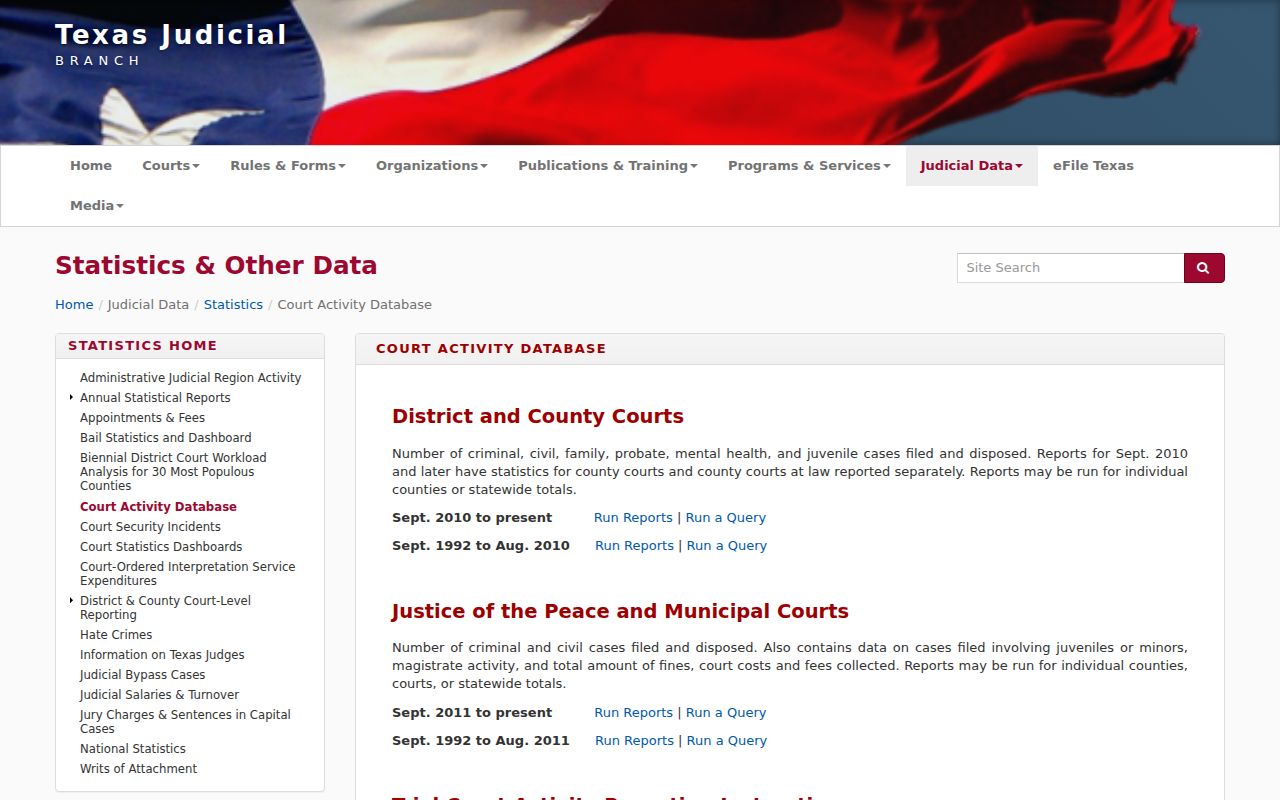
The ad hoc query screen next asks for two choices: a court type and a report section.
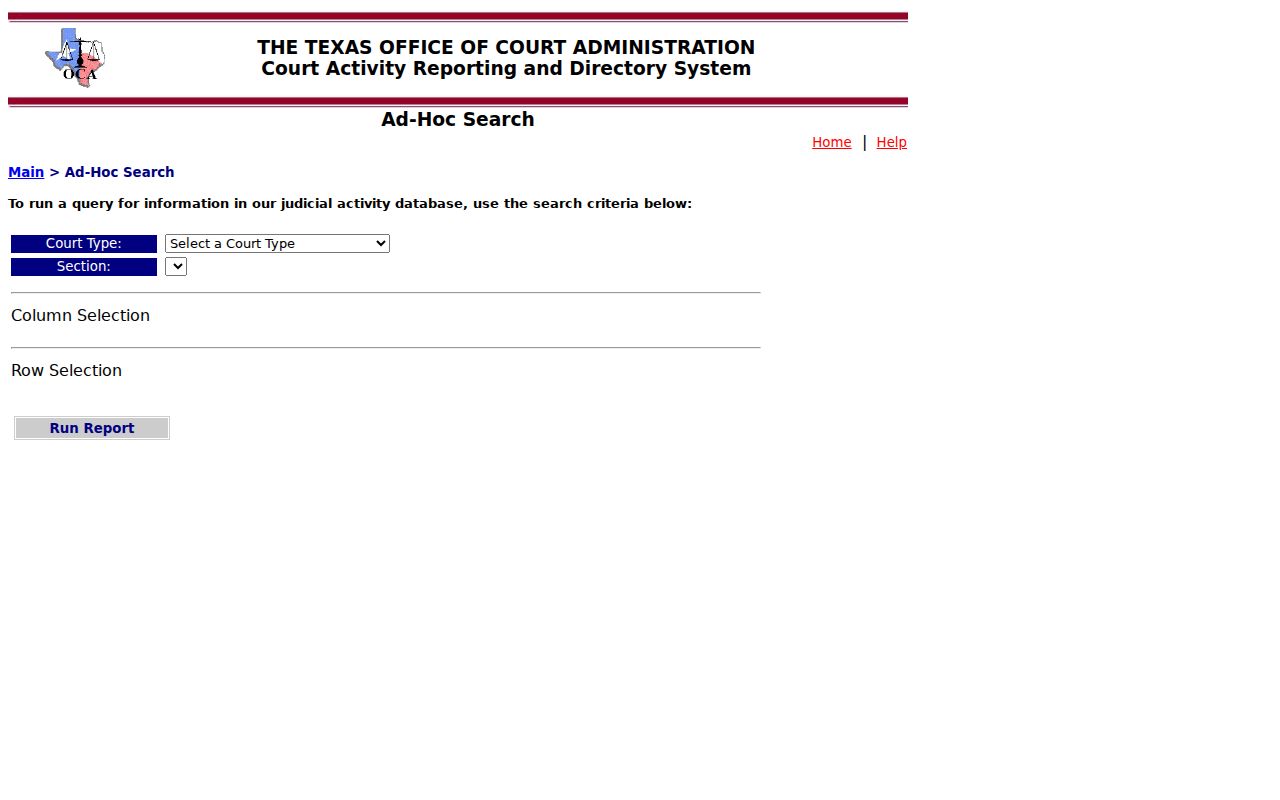
Next, the ad hoc query asks for a court type and a report section.
Hunt County Rule 12 Boundary
Rule 12 reaches only judicial records kept in regular court business that have nothing to do with deciding cases. It spells out custodians, exemptions, and an appeal route. What it is not: a blanket request law for the pleadings and orders inside a Hunt County case docket. The OCA access page draws that line clearly.
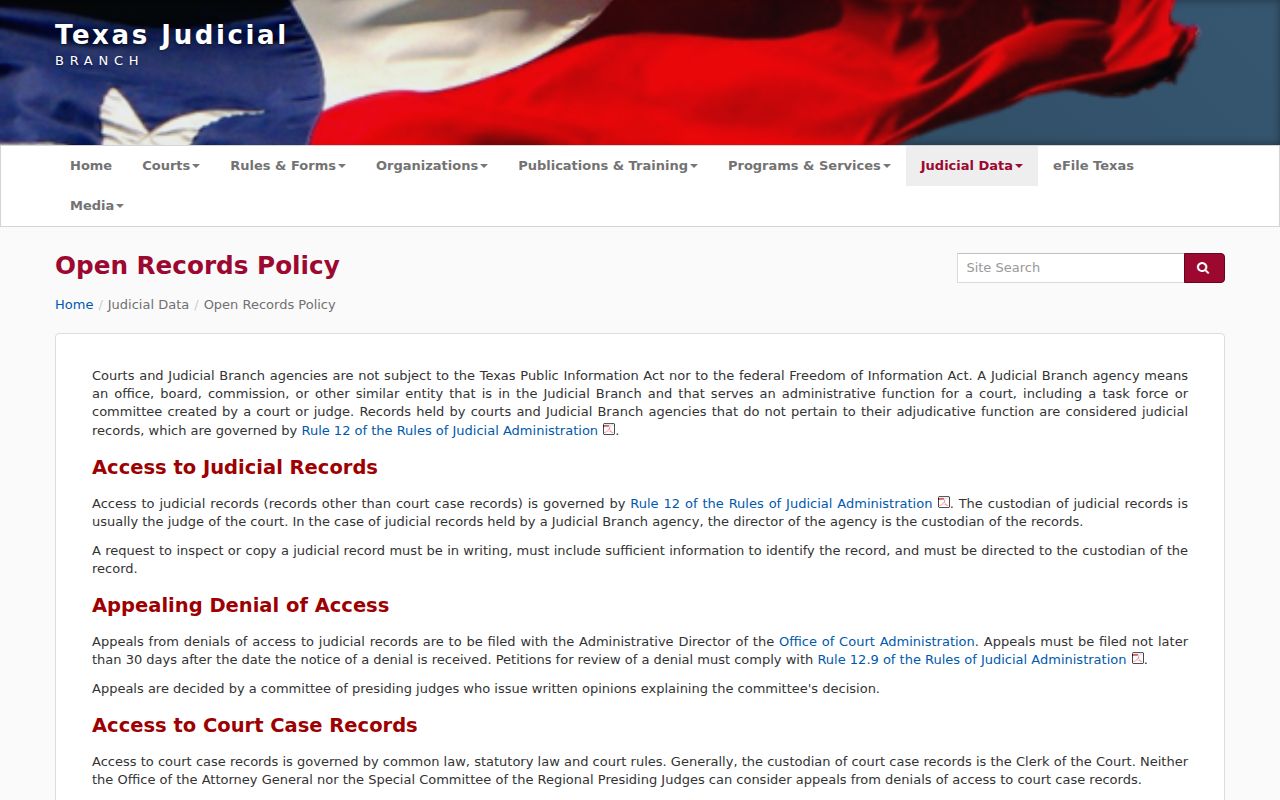
Rule 12 boundary: case documents and non-case judicial records travel on separate tracks in Hunt County. A case document belongs with the District Clerk, County Clerk, JP clerk, or municipal clerk. It depends on where the case was filed. Anything outside a case file works differently. There you must identify the Rule 12 custodian and follow that office's own process. That keeps a valid Hunt County request from heading down the wrong legal path.