
Searching Hunt County Civil Dockets
Grab the court name and cause number from a pleading, notice, or order first. The Hunt County Docket Search then shows published settings for a chosen date. Its public form has no stable party-name field. Leave the date blank for the next 30 days. You can also type MM/DD/YYYY or YYYY-MM-DD.
District civil and family files go to the Hunt County District Clerk. County civil, probate, and guardianship files go to the Hunt County Clerk. The assigned County Court at Law also keeps them. Small claims, debt claims, and evictions may sit in a Justice Court precinct. Work in that order:
- Copy the court, cause number, exact party spelling, and filing year.
- Use the county date tool to check a known civil setting.
- Search re:SearchTX by cause number or narrow party terms when available.
- Check the assigned court page and Hunt County local rules.
- Request the docket sheet, pleading, order, judgment, or certified copy from its clerk.
Hunt County Civil Court Routing
Route the case before you search it. The 196th and 354th District Courts try major civil and family matters within their jurisdiction. County Court at Law Nos. 1 and 2 take county civil, probate, and guardianship. They also take assigned cases. Justice Courts carry the lower-dollar civil categories under current Texas law.
| Matter | First court path | Record keeper |
|---|---|---|
| District civil or family filing | 196th or 354th District Court | Hunt County District Clerk |
| County civil case | County Court at Law No. 1 or No. 2 | Hunt County Clerk |
| Probate or guardianship | Assigned county court | Hunt County Clerk |
| Small claim, debt claim, or eviction | Named Justice Court precinct | Justice Court clerk |
Skip any dollar jurisdiction limit unless the current statute and the court assignment confirm it. The Hunt County court pages and the filed case header decide the route.
Inside a Hunt County Civil Docket
Think of a Hunt County civil docket as an event history. It is not the whole file. It proves a petition, answer, motion, or order was entered. A date-based view may cover only the chosen setting. A statewide electronic result may show different fields or document links.
| Court and cause number | Identify the tribunal and the key used to match the civil file. |
|---|---|
| Style and party roles | Names the caption and roles such as plaintiff, petitioner, defendant, or respondent. |
| Filing entry | Gives the date and title of a petition, answer, motion, exhibit, or other paper. |
| Setting | May show a hearing date, time, event type, judge, or location. |
| Status | Reports the system posture, which is not always a full statement of the merits. |
| Judgment or order | Identifies a dispositive paper when entered; the signed copy provides its terms. |
If only a setting appears, call it scheduled or listed. A filed motion is a request, never proof the relief was granted.
Hunt County Docket Versus File
Three products get mixed up here. A docket or calendar is an event trail. A filed document holds the parties' request or the court's own words. A certified copy carries the clerk's seal or certification. Each one answers a different civil research question.
| Question | Best source | What it proves |
|---|---|---|
| What is set? | Hunt County Docket Search | A published event at the time searched |
| What was filed? | re:SearchTX or clerk file | A filing entry or paper, subject to access |
| What happened? | Signed judgment or order | The court's recorded ruling |
| Is it certified? | Originating clerk | Certification and copy status |
A portal index is just a finding aid. The Hunt County Clerk's Tyler disclaimer likens it to a library card catalog and warns that images may be unavailable during backups.
Civil Case Types on the Docket
Hunt County civil dockets span several case families, and no single clerk holds them all. District civil work covers major claims and title or property disputes. It also covers family matters within District Court jurisdiction. County Courts at Law handle county civil and assigned proceedings. Justice Courts keep their own minor civil records.
- Contract, debt, tort, and property disputes assigned to a District Court or County Court at Law
- Family matters within District Court jurisdiction, subject to access limits
- Probate and guardianship matters maintained through the County Clerk
- Small claims, debt claims, and eviction proceedings in Justice Court
- Protective-order and other specialty proceedings with restricted fields
A deed index, foreclosure notice, or recorded instrument is not a civil docket entry by itself. Kofile QuickLink is an older recorded-record and index route. It is not the general Hunt County civil case register.
Hunt County Civil Assignment Rules
The Hunt County local rules lay out filing and assignment practices for civil, family, and criminal cases. They also cover probate, protective-order, and other cases. They explain why a case lands in a specific court. A party name alone never reveals a District Court assignment.
Copy the assigned court straight from the official case header. Then use that court's page for current procedure and the District Clerk for the papers. County Court at Law matters run through the County Clerk and that court's instructions. A transfer or consolidation can make an old routing note stale.
Civil Docket Settings and Hearings
A Hunt County civil setting might be a status hearing, motion hearing, or pretrial. It might be a bench trial or another event. County Court at Law No. 2 publishes weekday blocks for uncontested and contested civil matters. Those blocks also cover probate and guardianship matters. Those yearly schedules show court practice but never replace the current case-specific notice.
A reset or continuance moves a setting. It decides nothing. Follow the assigned court's procedure when a party asks for a change. Then look for the resulting order or updated event. Check the date tool against the court page and coordinator close to the hearing. The wider Hunt County Court Dates page walks through calendar channels in more depth.
Hunt County Civil Courts at Law
County Court at Law No. 1 and No. 2 each have their own page. Each courtroom has its own coordinator. Forms and procedural material differ too. Their published information helps confirm whether a county civil, probate, or guardianship setting belongs there. The County Clerk still holds the filed county-court record. The official County Court at Law No. 1 page appears below.
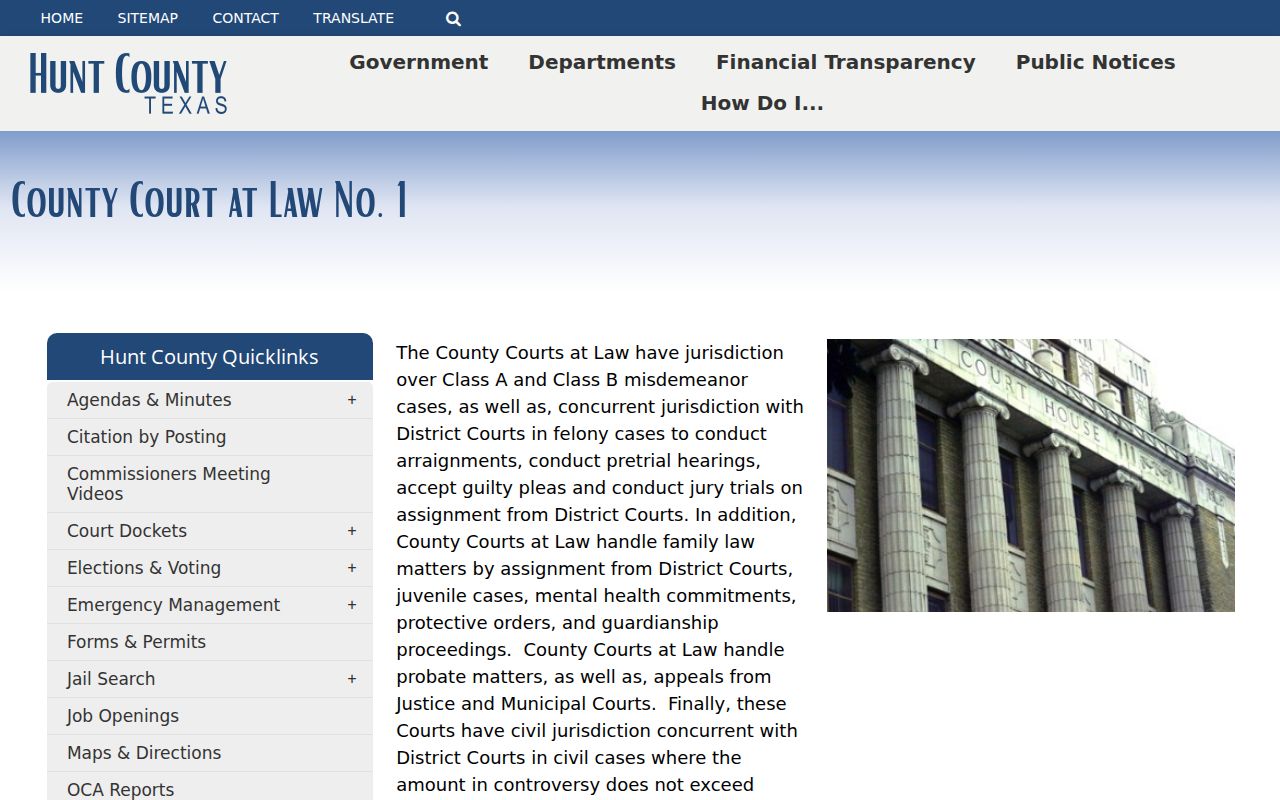
Its court card and jurisdiction details help route a Hunt County civil docket without treating the court page as the complete file. The official County Court at Law No. 2 page offers a separate local source.
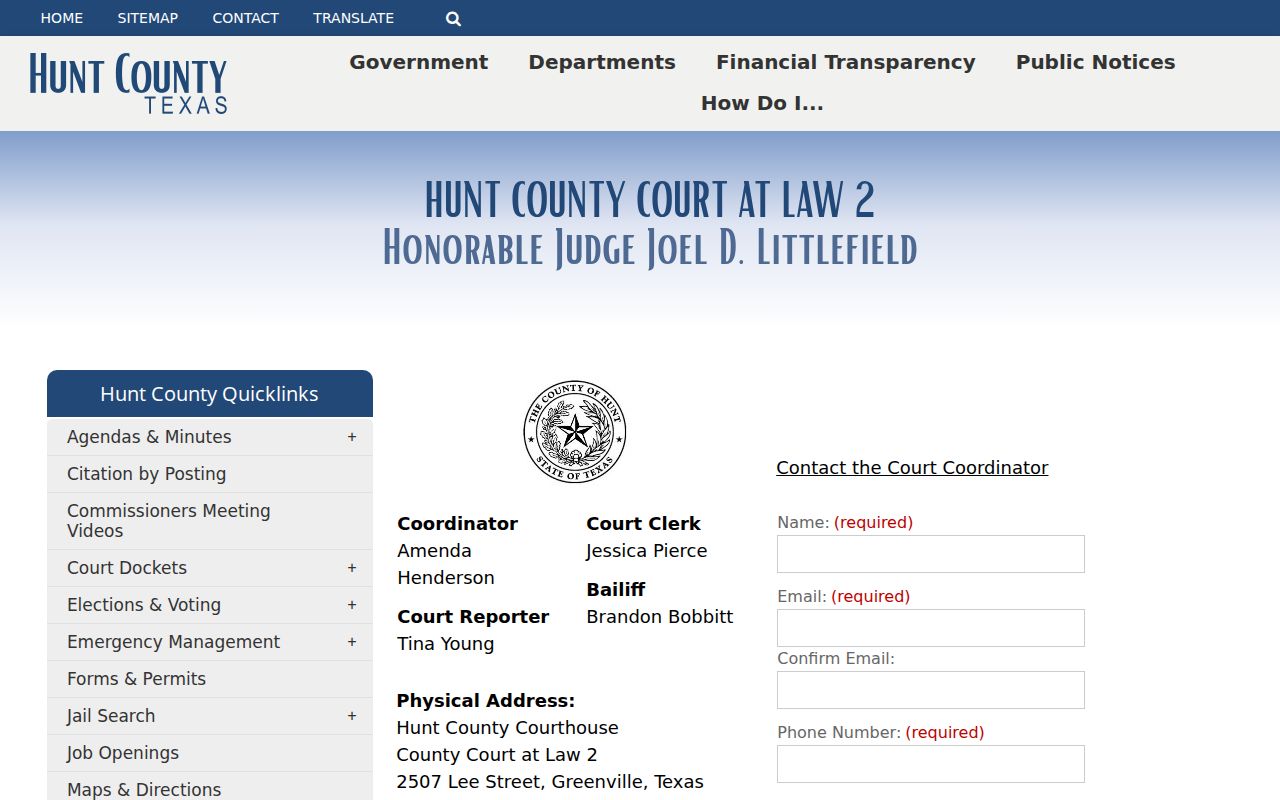
The second page reinforces why court-specific forms and setting notices must be checked independently.
Hunt County Civil Document Requests
District Court papers stay offline in Hunt County. The Hunt County District Clerk posts records for request rather than viewing. Its form wants real detail. List the cause number, each party, the filing year, case type, and the exact item you need. Have the cause number? eFileTexas takes the request. No number means email instead, to dclerk@huntcounty.net, or mail to P.O. Box 1437, Greenville, Texas 75403-1437.
Fees are set out on the form. A name search runs $5. The clerk waives it once you supply the case number. Paper copies cost $1 per page. Certification and seal add $5 per document. Electronic delivery is $1 for pages one through ten. Then it is $0.10 for each page after that. The clerk mails a Statement of Costs before filling any order. Certified copies go out by mail.
County civil, probate, and guardianship papers run through the Hunt County Clerk request route instead. There, copies are $1 per page, and only the office itself issues certified copies. Certification and authentication fees have appeared on the county's form. The fee schedule has not held steady online, so check current charges before you send payment.
Counties tweak paperwork often. Confirm the form and fees each time you request Hunt County court records, since a stale fee figure can delay an order.
Hunt County District Clerk
2507 Lee Street, Second Floor
Greenville, TX 75401
(903) 408-4172
Counter: weekdays 8:00 a.m. to noon and 1:00 p.m. to 5:00 p.m.
Hunt County Clerk
2507 Lee Street, Second Floor
Greenville, TX 75401
(903) 408-4130
Public search computers and clerk-assisted specific requests are available during published office hours.
Hunt County Civil Outcome Terms
Civil docket status words are not interchangeable. A nonsuit, dismissal, settlement, default judgment, summary judgment, final judgment, agreed order, temporary order, abatement, transfer, and appeal each mean something different. A case marked “Closed” may show only an index status, not the merits.
- Continuance
- A court-approved delay, usually followed by a later setting.
- Default judgment
- A judgment entered under applicable procedure when a party does not respond or appear; read the signed judgment.
- Temporary order
- An interim ruling that does not necessarily resolve every issue.
- Disposition
- A recorded result or status whose full meaning may require the order.
- Appeal
- Review in another court; track the appellate cause rather than assuming the trial status is final.
Copy the court's wording exactly when you note an entry. A motion is only a request. The ruling, and nothing earlier, tells you whether the court granted it.
Civil Docket Access Rules
Most Hunt County civil docket details are public, but not all. Some files arrive sealed, redacted, or restricted by rule. Family, juvenile, protective-order, guardianship, CPS, and mental-health cases tend to show less. And a missing image is not always a mystery. It may simply never have been digitized, or it could be down for now.
Texas access rules: Government Code §552.0035 places judiciary information under court rules or other law. Rule 12 policy separates administrative judicial records from court-case files. Family Code §85.007 protects addresses and phone numbers in protective-order records.
Several routes still get you there. The Hunt County date tool and the County Clerk online route remain open doors. So do public computers, the District Clerk email, mail, eFileTexas and counter routes, re:SearchTX, the assigned court page, and the Justice Court clerk. Ask the clerk directly what fits your need. That may be inspection, a plain copy, a redacted copy, or certification. What you want may not exist in every form. And never lean on a second portal to slip past a restriction the court has put in place.