
Searching the Hunt County Court Docket
The court name printed on your citation, notice, or order tells you where to begin. From there, the official Hunt County Docket Search pulls up published settings. You can filter by court and date. Dates go in as MM/DD/YYYY or YYYY-MM-DD. Leave the date empty and the tool defaults to the next 30 days of hearings. One caution applies. The public static form has no general party-name field. Treat it as a calendar tool rather than a full case index.
Before you search a Hunt County docket, gather a few things. Have the cause number, the exact spelling of each party, the filing year, and the case type. A matching date entry can confirm that an event is set. The clerk of the responsible court may still hold the complete history and any signed paper you need.
- Copy the exact court and cause number from an official case paper.
- Use Hunt County Docket Search for a court-and-date setting.
- Try the correct clerk or lower court when the date tool does not answer the question.
- Compare an integrated electronic case through re:SearchTX.
- Request the docket sheet, order, judgment, or certified copy from its custodian.
Hunt County Docket Search Fields
Hunt County keeps its search form simple on purpose. You pick a court and a date, then run the query. A blank date carries its own meaning here. The system returns the next 30 days rather than every case or an open-ended archive.
| Field | Type | Use |
|---|---|---|
| Select Court | Dynamic dropdown | Choose the court that issued the setting. |
| Date | Text or date | Use either accepted format, or leave blank for the coming 30 days. |
| Search | Button | Runs the selected court and date query. |
The source interface shown below confirms those three controls.
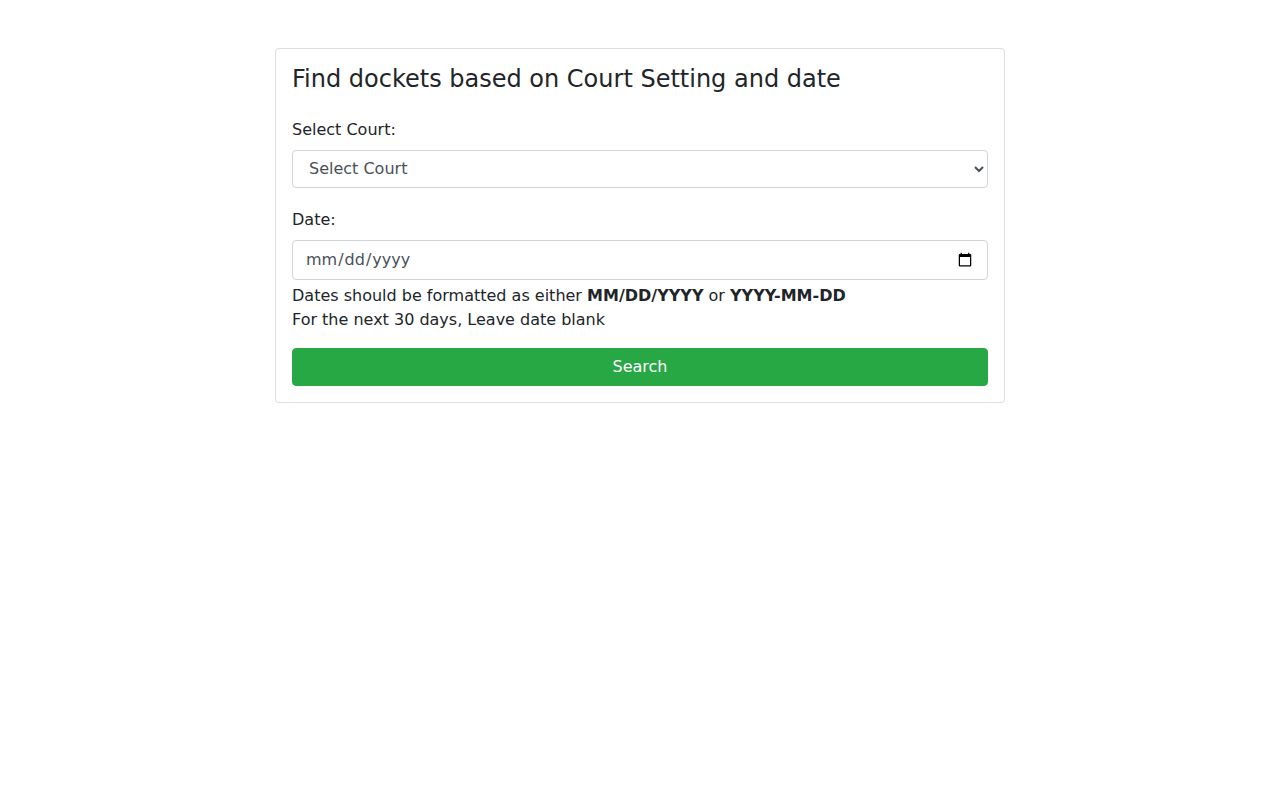
That layout is why a name-only Hunt County case lookup has to go through a different channel.
Inside a Hunt County Court Docket
Think of a Hunt County court docket as a running log of events. It may name the court, the cause number, and the case type. Parties, filings, settings, and current status can appear too. Some public views add a judge, courtroom, attorney role, or link to a document. Exactly which fields appear depends on the court and its system.
| Cause number | The court-assigned key used to match a case and request its file. |
|---|---|
| Style and roles | The case caption and labels such as plaintiff, petitioner, defendant, or respondent. |
| Filing entry | The date and description of a pleading, motion, order, or other paper. |
| Court setting | The date, time, and type of a listed hearing or docket call. |
| Status or disposition | System shorthand for posture or outcome, which may require the signed order for context. |
| Document access | A link, restricted marker, or clue that the clerk must supply the paper. |
Never read a setting as a result. A motion that was filed has not been granted. When the outcome matters, rely on the signed judgment, dismissal, decree, or other final instrument.
Hunt County Docket Split-Clerk Map
Record custody in Hunt County is split between two clerks. The Hunt County District Clerk holds the files of the 196th and 354th District Courts. Those files cover felony, district civil, and family filings. The Hunt County Clerk keeps County Court at Law records. They include county misdemeanors, county civil cases, probate, and guardianship. Justice and municipal courts each maintain their own lower-court dockets.
| Case clue | First custodian |
|---|---|
| Felony, district civil, or district family case | Hunt County District Clerk |
| County misdemeanor, county civil, probate, or guardianship | Hunt County Clerk |
| THP, sheriff, constable, or game-warden Class C citation | Justice Court shown on the citation |
| City police or ordinance citation | Issuing city's Municipal Court |
Matching the record type to the right office prevents a common mistake. Visitors often ask one Hunt County clerk for a file that belongs to the other.
Courts That Keep Dockets in Hunt County
The 196th and 354th District Courts sit at the top as general-jurisdiction trial courts. County Court at Law Nos. 1 and 2 carry statutory county jurisdiction plus assigned work. Four Justice of the Peace precinct groupings exist. They handle Class C criminal matters and minor civil disputes. Inside city limits, municipal courts take ordinance violations and state-law Class C cases.
| Court | Docket covers | Search path |
|---|---|---|
| District Courts | Felony, major civil, family, and related district matters | District Clerk, county setting tool, re:SearchTX where integrated |
| County Courts at Law | Misdemeanor, county civil, probate, guardianship, and assigned matters | County Clerk, county setting tool, court pages |
| Justice Courts | Class C citations, small claims, debt, and other minor civil cases | Named precinct clerk |
| Municipal Courts | City ordinance, traffic, and Class C matters | Issuing city's court |
Northeast Texas Child Protection Court No. 3 runs a regional specialty docket of its own. Federal cases belong to the Eastern District of Texas and PACER, not to any Hunt County state-court portal.
Hunt County Docket Portal Boundaries
Hunt County Docket Search, re:SearchTX, and eFileTexas each do a different job. The county tool publishes settings by date. re:SearchTX works as the statewide electronic court-record layer. Its content varies with integration, case type, public role, and security. eFileTexas handles electronic filings and transactions. The ability to file does not guarantee public viewing of documents.
The County Clerk also points users to county-authorized Tyler and iDocket routes for selected misdemeanor, civil, and probate material. Its own disclaimer compares an index to a library catalog. A catalog helps you locate a record. It is not the certified record itself. Under the District Clerk's request form, District Court documents cannot be viewed online. A missing image or empty result may simply mean you chose the wrong channel. It does not mean no Hunt County case exists.
How to Find Court Dates and Settings
Start with the court name. For those courts, run a Hunt County docket search. Filter by court and date. Then check the assigned court's official page and its current coordinator information. County Court at Law No. 2 posts schedules by weekday and case category. A yearly schedule is only a planning aid. It is never a case-specific order.
Municipal citations show the date and court right on the ticket. Each city system posts on its own delay and follows its own response rules. The regional child-protection court keeps a separate date selector and posting docket. Recheck close to the event. A reset, continuance, cancellation, holiday, or updated notice can move a setting. The Hunt County Court Dates resource walks through the full process.
Hunt County Docket Vocabulary
Each label on a Hunt County docket names a distinct event. Mix them up and a calendar entry can masquerade as an outcome. County Court at Law schedules use terms like docket call, contested matter, bench trial, pretrial hearing, bond hearing, and specifically set matter.
- Court setting
- A date and time assigned for a hearing, trial, docket call, or other event.
- Reset
- A new setting that replaces or moves an earlier setting.
- Continuance
- A court-authorized postponement, often followed by a new date.
- Disposition
- An outcome or status entry; the signed order gives the complete terms.
- Posting docket
- The public calendar format used by the regional child-protection court.
When both appear, note the entry date and the event date. They do not always fall on the same day.
Hunt County Docket Blank-Result Checks
An empty Hunt County court docket result does not prove a case is absent. First check whether the tool searches dates rather than names. Verify your date format and court selection. Then run the exact cause number through the responsible clerk or re:SearchTX. In the County Clerk index, small spelling variants can hide a party.
Older files may sit in paper, archive, or index-only form. Some simply never have been digitized. A public image can go offline during a backup. Juvenile, sealed, protective-order, mental-health, and child-protection records may display less detail by law or by order. Write down what you searched, when, and in which system nothing came back. That record beats turning an access gap into a factual claim about the case.
Public Access to Court Dockets
A single generic open-records request will not pull every Hunt County court record. Texas law treats court-case records as a category of their own. They stay with the clerk. They answer to applicable statutes, court rules, common law, and court orders. Rule 12 fits a different bucket. It covers judicial administrative records that sit outside the adjudicative case-record category.
Key rules:
Texas Government Code §552.0035 places judiciary information under court rules or other applicable law.
Texas Rule of Judicial Administration 12 supplies a route for non-case judicial records.
Texas Family Code Chapter 58 limits juvenile record access.
Texas Family Code §85.007 protects addresses and phone numbers in protective-order matters.
Even public access can leave names, identifiers, or documents redacted. Ask the actual Hunt County office holding the record whether inspection, a plain copy, a redacted copy, or certified proof is available.
Hunt County Sensitive Dockets
Some Hunt County dockets carry extra protection by nature. Juvenile, CPS, protective-order, guardianship, and mental-health files all fit that group. A search may reveal only a shell entry or a hearing category. The underlying document stays hidden. The regional CPS posting is a calendar artifact, not the District Clerk's complete case file. Never try to slip past a restriction through some other database. If a record is protected, ask which rule governs access. Ask also whether a redacted copy or a party-authorized route exists. An old index that exposed a field did not make republication proper. Good Hunt County docket practice preserves the public court event. It keeps protected addresses, child details, and personal identifiers out of circulation.
Docket Records at the Clerk's Office
District records live at the District Clerk's counter. You will find it on the second floor at 2507 Lee Street in Greenville. Published hours run weekdays from 8:00 a.m. to noon. Afternoons run 1:00 p.m. to 5:00 p.m. Requests reach the office through its directed email, mail, and eFileTexas paths. The form wants a cause number, the parties, the filing year, the case type, and the exact record requested. The official District Clerk page posts its Hunt County docket and records links. It also carries current office notices.
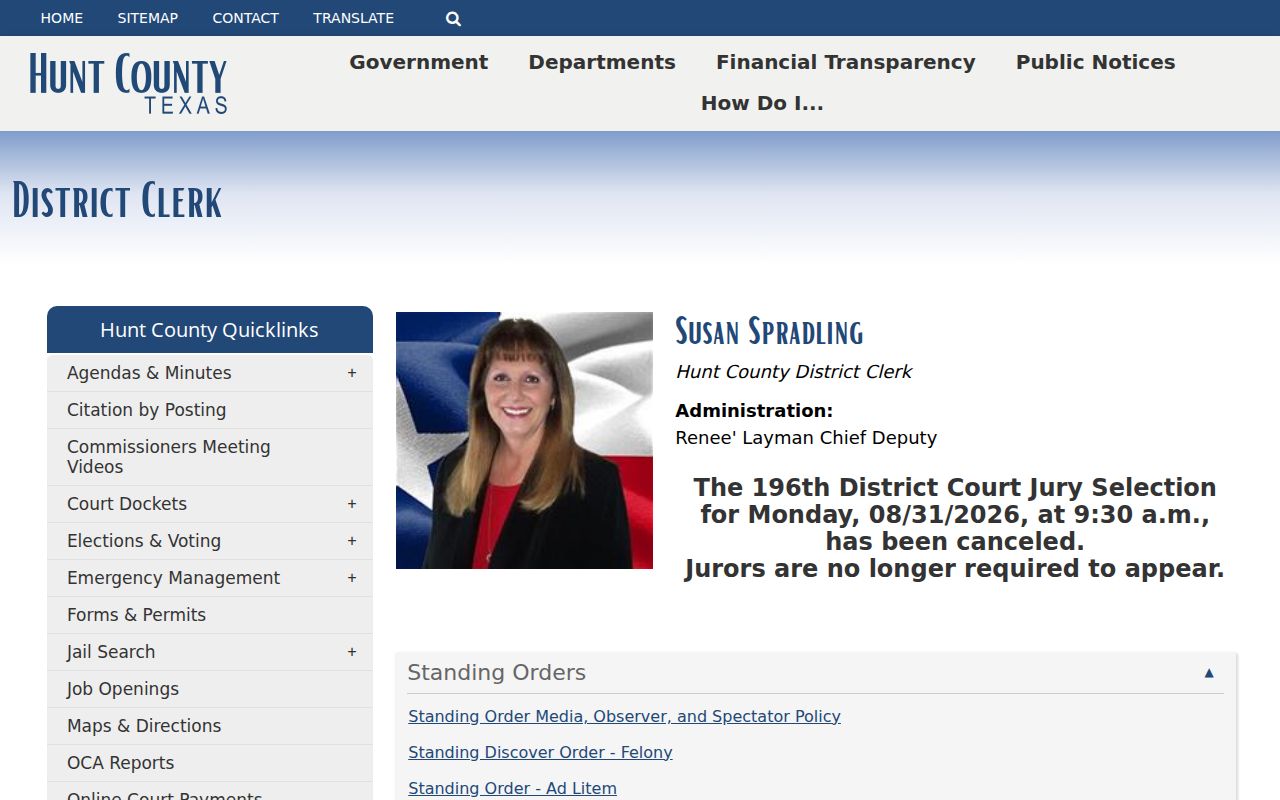
That page confirms the district-record route at its source. The County Clerk holds the judicial records of the county courts. Public search computers are available at the office. Its hours are narrower than general courthouse hours, including an earlier close on Friday. Bring the court, the case number, the names, the year, and the document type. Staff will retrieve records from specific information. But the office has no duty to run a broad search or guarantee correctness. The official County Clerk page spells out the office's distinct Hunt County docket duties.
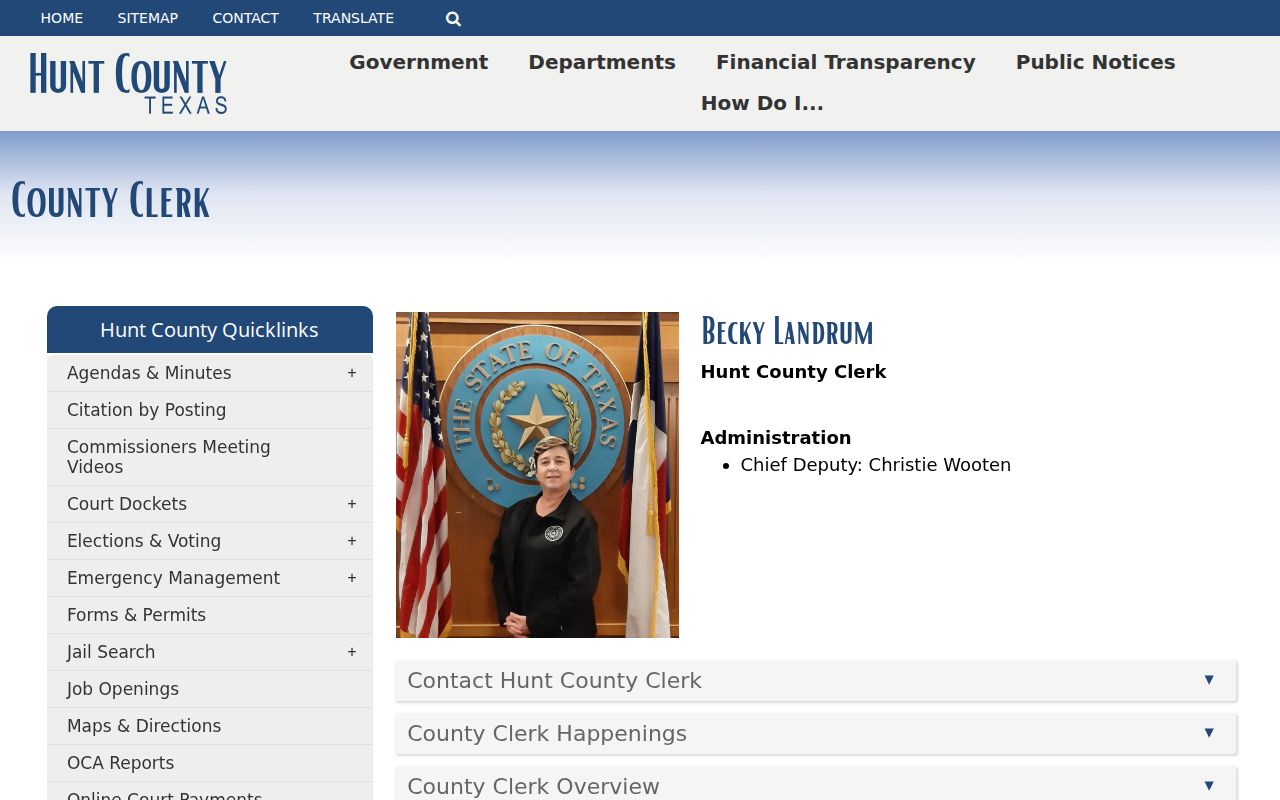
This separate source supports the county-court, misdemeanor, probate, and guardianship routing described above.
Hunt County District Clerk
2507 Lee Street, Second Floor
Greenville, TX 75401
(903) 408-4172
Hunt County Clerk
2507 Lee Street, Second Floor
Greenville, TX 75401
(903) 408-4130
Hunt County Docket Access Channels
District requests go through eFileTexas when you have a cause number. Without one, the District Clerk form points to email at dclerk@huntcounty.net or mail at P.O. Box 1437, Greenville, Texas 75403-1437. The form states plainly that the office gives no information by phone. A call can confirm procedure, but the documented request path is what counts. County Clerk judicial copies follow the county's stated online and office routes. The other paths are email to countyclerk@huntcounty.net or mail to P.O. Box 1316, Greenville, Texas 75403. Regular copies run $1 per page. Certification and authentication charges are added on top, so confirm the current amount before paying. When an online Hunt County index comes up short, the public computers still do the job. In-person inspection works too.
Hunt County Docket Courts in Context
The official Hunt County home page provides the courthouse and online-services context shown below.
The courthouse is a civic landmark. Still, Hunt County's court work does not sit under one roof. It spreads across county, district, JP, specialty, and city offices. The county population climbed from a 2020 Census count of 99,956. By a 2025 estimate it stood at 123,336. Growth alone does not prove a matching rise in filings. Case counts belong to the official Texas OCA reports, not to population ratios. The spread does explain why correct routing and current online access matter across a wide county. The OCA district-court summary for the reporting year ending August 31, 2024 gives a sharper workload frame. It lists 3,084 total district cases active and pending at the start. Another 2,752 were added during the year. The courts disposed of 3,069, and 2,753 were active and pending at the end. Those are district-court activity fields. They are not unique people, and they are not a total for every Hunt County court docket. Justice, municipal, and County Court at Law activity sit in other reporting groups. Anyone comparing years should hold the court level fixed. Keep the reporting period and OCA definition fixed too, instead of adding unlike totals. The Texas Court Activity Database is the official place to refresh that context. Pick the court type, Hunt County, the measure, and the reporting period, then save the query date. One caution: a setting count can include more than one event in a case. A filing count can include many documents. Clear labels keep those figures from being mistaken for a single countywide docket total.
Hunt County Court Dockets by City
Greenville, Commerce, Quinlan, Caddo Mills, and Wolfe City each run their own municipal procedures. A city police or ordinance matter starts in that city's court. A citation from a state trooper, sheriff, constable, or game warden works differently. The citation names a Justice Court. Start there. Match the paperwork to the court, not the other way around.
Greenville Docket Search
Municipal portal with ticket and name fields; new citations may take about 48 hours to appear.
Commerce Docket Search
City portal supports several citation, license, vehicle, name, and business search routes.
Quinlan Docket Search
Municipal court publishes a third-Monday setting and a processing delay; confirm questionable portal content with the clerk.
Caddo Mills Docket Search
Direct court procedure, response, and payment channels lead because no general public case query was documented.
Wolfe City Docket Search
Municipal forms and direct verification lead; keep the city court separate from JP Precinct 3.
Think of the city cards as gateways, not a merged Hunt County database. The court name and issuing agency printed on the record always control.
Map and Directions to the Hunt County Courthouse
The 196th and 354th District Courts' felony, family, and district civil files are kept by the District Clerk on the second floor of the Hunt County Courthouse, 2507 Lee Street in Greenville, a restored 1929 courthouse. The two district courtrooms themselves sit on the third floor, while County Court at Law No. 1 is fourth-floor Room 400 and County Court at Law No. 2's courtroom is on the second floor. The County Clerk's separate misdemeanor, civil, probate, and guardianship counter is also on the second floor.
Hunt County District Clerk
2507 Lee Street, Second Floor
Greenville, TX 75401
(903) 408-4172
Monday through Friday, 8:00 a.m. to noon and 1:00 to 5:00 p.m., closed for lunch.
No courthouse-wide parking, transit, or screening policy is published; call (903) 408-4172 before a visit to confirm current access, especially since county pages do not describe a general-lobby docket terminal.